Zuma and MK Party Escalate Legal War Against Ramaphosa with New Court Challenge
Zuma and MK Party Escalate Legal War Against Ramaphosa
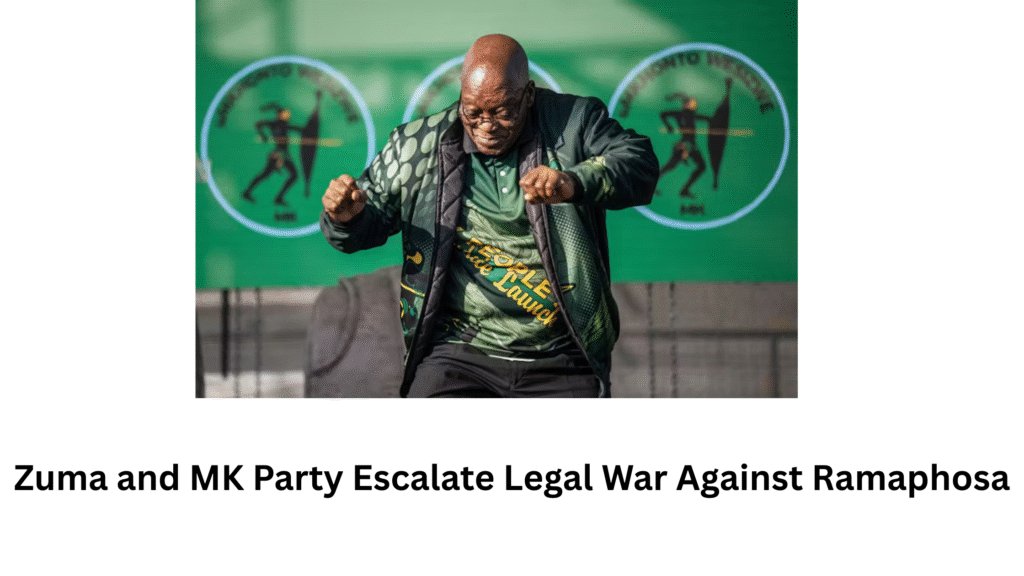
Former President Jacob Zuma and his uMkhonto weSizwe (MK) Party have intensified their legal confrontation with President Cyril Ramaphosa, launching a fresh court bid after suffering a setback in the Constitutional Court earlier this month. The dispute, which centers on the suspension of Police Minister Senzo Mchunu, the appointment of Professor Firoz Cachalia as acting minister, and the establishment of the Madlanga Commission of Inquiry, has deepened political tensions and sparked debate over presidential powers in South Africa.
Background to the Legal Battle
In July 2025, the MK Party filed an urgent application in the Constitutional Court, challenging President Ramaphosa’s recent executive decisions. They sought to have his actions declared unconstitutional, particularly the decision to appoint an acting police minister from outside Cabinet. Zuma and his allies argued that these steps violated the separation of powers and undermined democratic governance.
However, on 31 July 2025, the Constitutional Court dismissed the application, ruling that the matter did not fall within its exclusive jurisdiction and should instead be heard by a lower court. The judges emphasized that the case raised questions better suited for the High Court, effectively closing the door to direct intervention by the country’s highest court.
MK Party Reaction: “A Travesty of Justice”
The MK Party swiftly condemned the Constitutional Court’s ruling, describing it as a “travesty of justice.” Party spokesperson Nhlamulo Ndhlela accused the judiciary of applying double standards, pointing to the court’s 2021 decision that had allowed Zuma to be jailed for contempt of court without trial.
“This is the same court that granted direct access to incarcerate President Jacob Zuma, but when faced with Ramaphosa’s delinquency, it suddenly hides behind technicalities,” Ndhlela said. The MK Party vowed to pursue every available legal avenue to hold Ramaphosa accountable, framing the battle as a defense of constitutional principles.
The New High Court Challenge
Unwilling to let the matter rest, Zuma and the MK Party have now taken their case to the North Gauteng High Court in Pretoria. In their urgent application, they ask the court to declare Ramaphosa’s decisions:
- Placing Senzo Mchunu on leave invalid and unconstitutional.
- Appointing Prof. Firoz Cachalia as acting Police Minister null and void.
- Establishing the Madlanga Commission of Inquiry unlawful.
Legal analysts suggest the new challenge could test constitutional boundaries, especially regarding the question of whether a sitting president can appoint a minister from outside his Cabinet, even temporarily.
Analysts Weigh In
Opinions among experts are divided. Some argue the High Court challenge is a waste of time and resources, stressing that the president has broad constitutional powers to manage the executive. Others, however, contend that the appointment of an outsider as acting minister is uncharted legal territory that deserves closer judicial scrutiny.
Political observers also warn that the case could fuel further instability. With Zuma still commanding loyalty among parts of the electorate, the MK Party is using legal avenues to sustain pressure on Ramaphosa, while framing itself as the guardian of accountability.
Broader Political Implications
This legal war comes against the backdrop of mounting political rivalry ahead of South Africa’s next general election. The MK Party has consistently accused Ramaphosa of abusing his office and betraying the liberation movement’s principles, while the ANC leadership views Zuma’s camp as destabilizing forces exploiting the judiciary for political gain.
The outcome of the High Court case could shape not only Ramaphosa’s authority but also set precedents about executive powers in South Africa. If the MK Party succeeds, it may curtail presidential discretion in appointing acting ministers. If it fails, Ramaphosa’s grip on the executive will be strengthened, and the MK Party risks being seen as pursuing futile legal battles.
Timeline of Key Events
| Date | Event |
|---|---|
| 30 July 2025 | Constitutional Court hears Zuma/MK application |
| 31 July 2025 | ConCourt dismisses bid, refers matter to High Court |
| Early August | MK Party denounces ruling as biased, vows further action |
| August 2025 | Zuma and MK Party file urgent High Court application in Pretoria |
Conclusion
Jacob Zuma and the MK Party’s decision to escalate their fight to the High Court underscores the deep divisions in South African politics. While the legal arguments may seem technical, the political stakes are high: the case touches on executive authority, constitutional interpretation, and the credibility of both Ramaphosa and the judiciary.
As the court battle unfolds, South Africans will be watching closely to see whether the law sides with the president’s prerogatives or with Zuma’s relentless campaign to challenge his leadership.