
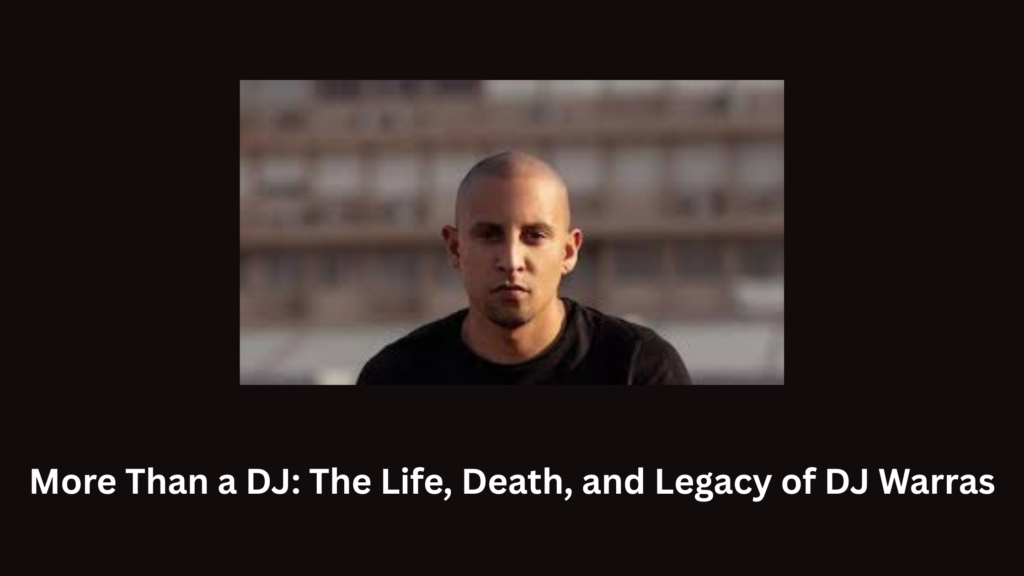
A Nation Mourns: The Tragic Death of DJ Warras
On the afternoon of Tuesday, 16 December 2025, South Africa was shaken by the violent killing of Warrick Robert Stock, better known to millions as DJ Warras — a beloved radio and television personality, club DJ, podcaster, and creative force whose career spanned nearly two decades. Shot in broad daylight in Johannesburg’s Central Business District (CBD), his death highlighted not only the senseless loss of one of the country’s most dynamic media figures but also the grim realities of escalating criminality that increasingly plague urban centres. Wikipedia+1
From Durban Roots to National Fame
Born on 27 November 1985 in Durban, KwaZulu-Natal, Warrick Stock grew up with a deep love for music, culture, and storytelling. His grandfather played a profound role in shaping his early years, imparting a passion for community and communication that would follow him throughout life. Multilingual and charismatic, Stock could effortlessly connect with listeners in English, Zulu, and Afrikaans — a rare and cherished quality in South African broadcasting. Wikipedia
His journey into media began in 2008 at YFM, where his confident voice and magnetic personality quickly garnered attention. From there, he joined 5FM, hosting The 5th Element, a popular evening show that became a fixture for young music lovers across the nation. His reach soon expanded to television with appearances on SABC1’s Live AMP, among other shows, and later as co-host of the widely followed The Shady PHodcast. South African Government
Beyond radio and TV, DJ Warras embraced the digital age, cultivating a strong presence online and mentoring emerging creatives. His influence spanned generations — from seasoned music aficionados to new talent seeking guidance in the competitive world of entertainment. South African Government
The Day of Reckoning: 16 December 2025
South Africans had barely marked the national holiday of Day of Reconciliation when tragedy struck. Shortly after midday in Johannesburg’s bustling Hillbrow district — near the iconic Carlton Centre — Warrick Stock was ambushed. According to police and witness reports, he had parked on Commissioner Street outside the Zambesi House, a building he had been inspecting due to his involvement with security operations there, when three suspects approached him. Moments later, at least one gunman opened fire at close range. Stock collapsed in the street and was pronounced dead at the scene. He was just 40 years old. Wikipedia
Johannesburg police confirmed the shooting and launched a murder investigation. CCTV footage reportedly shows a suspect — a short man with dreadlocks — firing at Stock and fleeing on foot with accomplices; cartridges were recovered at the scene. Authorities also indicated that the attack was not a drive-by but a targeted ambush. Wikipedia
A Broader Battleground: Crime, Protection Orders, and Urban Decay
While the precise motive remains under investigation, there are indications this was not random violence. Johannesburg’s Member of the Mayoral Committee (MMC) for Public Safety, Dr Mgcini Tshwaku, revealed that Stock had obtained multiple protection orders against at least five individuals following threats prior to his death — a fact that has led investigators to consider this a targeted hit rather than a spontaneous attack. These orders were reportedly connected to disputes over security work at the Zambesi House and other “hijacked” buildings in the inner city, where illegal occupation and criminal syndicates complicate law enforcement and safety. Daily News+1
Complicating matters, local reports indicate police have also identified a woman as a person of interest in the case, allegedly connected to hijacked building networks and named in one of the protection orders. Authorities have taken several persons of interest in for questioning, though as of the latest updates no arrests have been formally made, and investigators continue to follow leads and analyze evidence. Channel Africa+1
The involvement of urban decay issues — particularly the phenomenon of ‘hijacked buildings’ (properties illegally occupied and controlled by criminal networks) — underscores one of South Africa’s most urgent societal challenges. The African National Congress (ANC) has called for community participation in tackling this crisis, urging citizens to support police efforts and make use of available resources to restore law and order in inner cities. TimesLIVE
Outpouring of Grief and Tributes
The news of DJ Warras’s death reverberated across the country. Colleagues, fans, family members, and political figures alike expressed profound sorrow at the loss of a vibrant voice in South African media. Condolences poured in from across entertainment and public life, with many highlighting not only his talent but his generosity, mentorship, and commitment to his community. Music In Africa
Officials from the Department of Sport, Arts and Culture, including Minister Gayton McKenzie, extended their deepest sympathies, praising Stock’s contributions to the media and creative industries and acknowledging the enduring impact of his work on young South Africans. South African Government
Fans and friends took to social media to remember him as a loving father, an inspirational figure, and a “patriot who fought for his community’s future.” These tributes reflect a nation still trying to process the sudden and senseless loss. Daily News
Legacy and Reflection
DJ Warras’s death raises important questions about the state of safety, justice, and civil responsibility in South Africa’s urban centres. While his career was rooted in celebration — music, culture, conversation — his final years were also marked by a growing engagement with the difficult realities of inner-city life and criminality. His work in private security and building reclamation placed him on the front lines of a conflict many residents experience firsthand: the struggle to reclaim spaces stolen by criminal networks and restore them for lawful use and community benefit. Daily News
Critics and commentators argue that the continued plague of violent crime not only endangers individuals but also erodes public confidence in institutions meant to protect citizens. Security experts have noted that cases like Warras’s — where protection orders and legal processes failed to prevent tragedy — highlight systemic challenges in confronting organized crime and violent networks. eNCA
Yet, even amid grief and outrage, many see his legacy as one of hope. DJ Warras’s voice championed South African creativity; his presence on air and on screen helped shape cultural conversations. He gave emerging artists platforms, encouraged discourse across divides, and brought laughter and insight to countless listeners. That legacy now carries an added weight — a reminder of both what has been lost and what continues to be worth fighting for. South African Government
The death of DJ Warras was more than the loss of a popular entertainer. It was the abrupt end of a life that resonated deeply with a nation’s youth and creative communities and a stark illustration of the challenges facing South Africa today. As investigations continue and the search for justice unfolds, his story compels reflection — on crime, on community, and on the enduring power of the human spirit.